
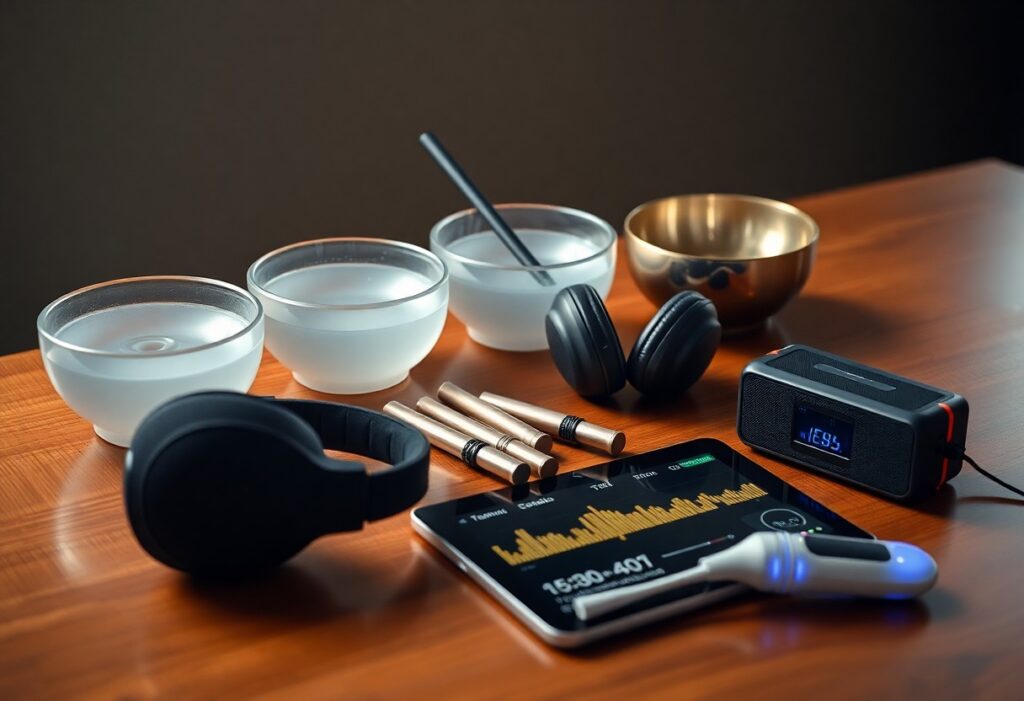

With precise frequencies affecting brainwaves and physiology, you can harness sound to reduce stress, sharpen focus, and speed recovery; this article explains seven evidence-based mechanisms-entrainment, binaural beats, music tempo, low-frequency vibration, white noise, harmonic resonance, and guided auditory therapy-so you understand how to apply sound strategically in your daily life.
Key Takeaways:
- Low-frequency (delta/theta) sounds activate parasympathetic responses, lowering cortisol and aiding sleep and physical recovery.
- Alpha/beta frequencies and targeted binaural beats boost alertness, working memory, and task-focused attention.
- Tempo and rhythm modulate arousal: slow tempos calm, steady beats sustain focus, fast tempos increase energy.
- Harmonic, consonant timbres tend to reduce stress and negative emotion; dissonance and harsh spectra elevate tension.
- Individual differences and context shape outcomes; personal preference, expectations, and prior associations influence effectiveness.
- Clinical and wellness applications (music therapy, sound baths, auditory stimulation) support anxiety reduction, pain management, and rehab.
- Volume, exposure duration, and delivery method determine benefit versus harm; avoid excessive loudness and prolonged exposure.
The Science of Sound Frequencies
Studies link specific frequency bands to measurable physiological responses: infrasound (<20 Hz) can affect balance and mood, the audible band (20-20,000 Hz) drives cochlear mechanics and speech perception, and ultrasound (>20 kHz) serves diagnostic roles. When you use targeted tones – for example 40 Hz entrainment shown to enhance gamma synchrony in animal models – your nervous system and hormonal markers like cortisol can shift within minutes.
Understanding Sound Waves
Sound is defined by frequency (Hz), amplitude (dB), wavelength and phase; frequency determines pitch while amplitude maps to loudness you perceive. For instance, A4 at 440 Hz is standard tuning, bass around 60 Hz produces a tactile sense, and a 6 dB increase roughly doubles perceived loudness. You can manipulate these parameters to favor relaxation, alertness, or physical stimulation.
The Frequency Spectrum
The spectrum breaks into functional bands: sub-bass (<60 Hz) yields body vibration, bass (60-250 Hz) supports warmth, mids (250-2000 Hz) carry melody and much speech, and highs (2-20 kHz) add clarity and air. Speech intelligibility concentrates between 1-4 kHz, so when you boost or cut those frequencies you directly affect comprehension and focus in mixed audio or therapeutic tones.
Further detail shows cochlear tonotopy maps high frequencies at the base and lows at the apex, which explains why a 4 kHz tone stimulates different hair cells than a 100 Hz tone. You can also use beat phenomena: binaural beats with a 10 Hz difference tend to increase alpha power, while 40 Hz stimulation targets gamma; clinical studies report small-to-moderate reductions in anxiety and improvements in attention with tailored protocols.
Sound and Stress Reduction
You can use targeted frequencies to shift your physiological stress responses: alpha (8-13 Hz) and theta (4-7 Hz) rhythms are linked to lowered heart rate and reduced subjective anxiety, and 15-30 minute sessions of music or binaural beats often produce measurable drops in sympathetic activity. Clinical examples include preoperative music interventions and mindfulness-with-sound protocols that lower reported anxiety and stabilize blood pressure within a single session.
The Role of Sound in Relaxation
When you listen, auditory-driven neural entrainment nudges cortical oscillations toward alpha/theta bands, increasing parasympathetic tone and vagal activity while suppressing the fight-or-flight response; binaural beats around 6 Hz reliably enhance theta, ambient tracks at 60-80 BPM align with resting heart rate, and slow temples reduce cortisol and subjective tension in both lab and field studies.
Practical Applications for Stress Relief
You can apply sound-based tools across daily routines: use 10-20 minutes of alpha-targeted music for pre-work focus, 15-30 minutes of theta/binaural-beat sessions for evening wind-down, or 3-5 minute nature-sound microbreaks during stressful tasks; headphones yield the strongest entrainment effects, and consistent daily exposure produces larger cumulative benefits.
Try these concrete protocols: before a tense meeting, play 8-10 Hz alpha binaural beats for 5-10 minutes; for acute panic, breathe at 6 breaths/min while listening to 0.1 Hz pulse tones for 3-5 minutes to engage baroreflex-mediated calming; for sleep initiation, combine 20-30 minutes of 4-7 Hz theta tones with low-volume pink noise to reduce sleep latency and nocturnal arousals.
Enhancing Focus with Sound
When you design sound deliberately, you can shift brainwaves toward sustained attention: alpha (8-13 Hz) fosters calm alertness, while gamma (~30-50 Hz, often 40 Hz) supports selective attention and working memory. Try short, 25-50 minute focused blocks with a consistent background-pink noise at ~45-55 dB or a low-volume binaural beat-to reduce distractions and improve accuracy on detail tasks; many users report measurable productivity gains within a week of systematic use.
Soundscapes for Concentration
You benefit from tailored soundscapes-steady pink or brown noise masks intermittent disruptions, nature ambiances (rain, wind, forest) lower perceived distraction, and engineered binaural beats (e.g., 440 Hz left / 450 Hz right to produce a 10 Hz beat) nudge alpha rhythms. Set volume to a comfortable baseline (roughly 40-55 dB), test during a 25-minute Pomodoro, and track task completion rate to find the optimal profile for deep work.
Music and Productivity
You should match music attributes to task demands: instrumental tracks in the 60-80 BPM range suit creative, divergent work by aligning with your resting heart rate, while 100-140 BPM supports repetitive, high-energy tasks. Avoid lyric-heavy songs for complex cognitive work, and consider playlists with gradual tempo changes to maintain momentum across longer sessions.
For practical implementation, build three playlists: mellow instrumental (60-80 BPM) for ideation, steady rhythmic (100-130 BPM) for execution, and ambient/pink-noise mixes for high-concentration blocks. Rotate every 25-50 minutes, keep levels around 45-55 dB, and experiment with brief 5-10 minute gamma (40 Hz) or alpha (10 Hz) binaural-beat interludes to re-center attention between sessions. Track accuracy and completion time to quantify improvement.
Sound for Recovery and Healing
You can use targeted sound to accelerate physical and mental recovery by reducing sympathetic arousal, improving sleep architecture, and promoting tissue-focused relaxation. Clinical and applied protocols often pair low-frequency vibration (20-120 Hz) with guided breathing to lower heart rate and cortisol; in practice you’ll see session lengths of 20-45 minutes produce measurable shifts in HRV and subjective pain within 2-4 weeks.
Therapeutic Uses of Sound
You’ll find sound applied across modalities: vibroacoustic therapy for musculoskeletal pain, binaural beats for anxiety reduction and focus, music therapy for motor rehabilitation, and ultrasound-guided acoustics for wound healing. Typical dosing ranges from daily 10-30 minute binaural sessions to thrice-weekly 30-45 minute vibroacoustic treatments, with effect sizes often emerging after 3-6 sessions.
Case Studies in Sound Therapy
You can evaluate outcomes from mixed clinical reports showing symptom reductions and functional gains; several case series report 25-50% mean improvements in pain or sleep metrics, while randomized pilots show small-to-moderate effect sizes on anxiety and mood. These examples illustrate how protocol, frequency, and session duration shape recovery trajectories.
- Hospital Rehab – Vibroacoustic therapy, n=120, 6-week program, 30-min sessions ×3/week: mean VAS pain dropped 38% (6.2→3.8); Timed Up and Go improved 22%.
- Chronic Low Back Pain Clinic – Sound-music intervention, n=68, 8 weeks: ODI disability scores decreased 31%; analgesic use fell by 18%.
- Insomnia Pilot – Binaural beats, n=45, 4 weeks nightly: sleep onset latency reduced 27% (from 42 to 31 minutes); PSQI global improved 3.4 points.
- PTSD Residential Program – Group drumming + guided sound, n=32, 12 weeks: PCL-5 scores decreased 19% and salivary cortisol reduced by 15% post-intervention.
- Postoperative Recovery – Low-frequency vibration applied to incision site, n=50, single week: opioid consumption reduced 24% and reported pain scores fell 2.1 points on a 10‑point scale.
You should analyze these reports for methodological differences-sample size, control condition, blinding, and outcome measures vary widely-so replicate protocols that match your target outcome and monitor objective markers (HRV, cortisol) alongside subjective scales to validate effects.
- Stroke Rehabilitation Case Series – n=40, music-cued motor retraining, 10 weeks: Fugl-Meyer motor scores improved 15% and gait speed increased 18%.
- Fibromyalgia Cohort – Therapeutic sound baths, n=56, 8 sessions: mean pain reduction 29%; fatigue scores improved 21% at 1-month follow-up.
- ICU Recovery Study – Ambient therapeutic soundscape, n=90, continuous 72-hour exposure: delirium incidence dropped from 28% to 12%; length of stay decreased 1.4 days.
- Depression Adjunct Trial – Binaural beat sessions, n=84, 6 weeks adjunct to SSRI: HAM-D scores decreased 34% vs 18% in control (standard care alone).
- Chronic Tinnitus Pilot – Tailored notched music therapy, n=38, 12 weeks: tinnitus loudness ratings fell 26% and THI handicap scores improved 22%.
The Connection Between Sound and Emotions
Across everyday moments you can notice how a simple tone shifts mood: infrasound (<20 Hz) often produces unease, alpha (8-13 Hz) promotes calm, and theta (4-7 Hz) deepens introspection. You can also link 40 Hz gamma to heightened attention-rodent studies (Martorell et al.) showed 40 Hz sensory stimulation reduced amyloid burden and improved behavior-demonstrating that specific frequencies correspond to measurable emotional and neurophysiological outcomes.
Emotional Responses to Different Frequencies
Low frequencies (17-80 Hz) intensify arousal and physical sensations-reports link ~17-20 Hz infrasound to fear-like feelings-while mid-range alpha/theta entrainment (8-13 Hz; 4-7 Hz) reliably lowers anxiety and enhances creativity in several trials. Binaural beats at 10 Hz have reduced pretest and preoperative anxiety in randomized studies, and gamma (30-50 Hz) activity correlates with focus and cognitive engagement during demanding tasks.
Leveraging Sound for Mental Well-Being
You can design targeted routines: 10-20 minutes of alpha binaural beats for instant relaxation, 20-30 minutes of theta soundscapes for meditation, 30-60 minutes of pink noise to improve sleep stability, and brief 40 Hz sessions to stimulate cognitive networks. Headphones are required for binaural beats, and pairing sound with paced breathing or guided imagery amplifies outcomes.
Practical implementation matters: most intervention studies use 15-30 minute sessions at safe volumes (avoid >85 dB), with daily or every-other-day application for 1-3 weeks to achieve measurable shifts in mood or cognition. You should use stereo headphones for binaural protocols and room speakers or isochronic tones for group or ambient approaches, track sleep/mood with simple logs, and combine sound with behavioral tools-paced breathing (6 breaths/min), mindfulness, or brief cognitive tasks-to maximize transfer into daily functioning.
Creating Your Sound Environment
You can shape your immediate soundscape to support work, sleep, or healing by controlling levels, spectra, and timing: aim for 40-55 dB for focused work, keep sleep zones below ~35 dB, and use targeted frequency tools (alpha 8-12 Hz for relaxed focus, theta 4-8 Hz for deep relaxation, gamma ~40 Hz for memory). Practical moves include adding absorptive panels (NRC 0.7-0.9), swapping hard floors for rugs to cut reverberation, and scheduling sound cues tied to routines.
Tips for Curating Your Sound Space
Prioritize source control, path treatments, and selective masking: place noisy equipment behind barriers, install 2-4 strategically located 60×60 cm panels to reduce midrange reflections, and schedule 25-50 minute focused sessions with consistent background sound. Recognizing that even 3 dB changes alter perceived loudness by ~25%, tune levels incrementally to find the sweet spot for your tasks.
- Use pink or brown noise at 40-45 dB to mask intermittent distractions.
- Choose binaural beats in headphones for 10-20 minute transitions (alpha/theta ranges).
- Add soft furnishings and plants to lower high-frequency reflections by 5-8 dB.
- Measure with an SPL meter or smartphone app (calibrated) before and after changes.
Tools and Technology for Sound Management
You should leverage both hardware and software: active noise-cancelling headphones (ANC) typically reduce 15-30 dB in the low end, sound-masking systems deliver consistent pink noise at set dB levels, and apps like Brain.fm, Noisli, or OpenSoundLab provide curated, research-based soundscapes. For room assessment, use Room EQ Wizard with a calibrated mic to measure RT60 and SPL.
For deeper tuning, combine parametric EQ, a DSP-based crossover, and physical treatment: add bass traps for frequencies under 250 Hz, mid/high panels for 500-4,000 Hz, and set target RT60 under 0.6 s for speech-heavy spaces. When using binaural protocols, ensure stereo headphone delivery and keep the interaural beat difference under 30 Hz for safety and effectiveness.
Final Words
On the whole, you can harness targeted sound frequencies to lower stress, sharpen your focus, and accelerate recovery by integrating deliberate listening practices, binaural or isochronic tones, and ambient soundscapes into your routine; applying these methods consistently lets you measure effects and tailor protocols to your physiology for better wellbeing and performance.
FAQ
Q: What are sound frequencies and how do they influence stress, focus, and recovery?
A: Sound frequency is measured in hertz (Hz) and describes how many sound wave cycles occur per second. Different frequency ranges interact with the nervous system and brain rhythms: low frequencies (sub-100 Hz) produce body-centered sensations and can slow breathing and heart rate; mid frequencies carry most musical and speech content that influences mood; high frequencies can increase alertness and cortical arousal. Through mechanisms such as auditory-driven autonomic shifts and brainwave entrainment, specific frequencies and patterns can reduce stress markers (like heart rate and cortisol), enhance concentration by stabilizing attention-related brain oscillations, and support recovery by promoting sleep-friendly brain states and parasympathetic activation.
Q: How do low-frequency sounds (bass tones) affect relaxation and stress levels?
A: Low-frequency tones stimulate the body as much as the ear; they can induce a grounding, calming effect by encouraging slower breathing, deeper exhalation, and vagal activation when presented at moderate volume. Isochronic or sustained low tones around 40-60 Hz are often used in relaxation tracks to promote a sense of safety and reduced sympathetic arousal. Excessive loudness or unexpected low-frequency noise, however, can be intrusive and increase stress, so controlled, predictable low-frequency exposure is most effective for relaxation.
Q: Can high frequencies and brighter sounds improve focus, or do they increase stress?
A: Higher-frequency content tends to increase cortical alertness and sensory discrimination, which can help short-term vigilance and cognitive processing. Bright, clear sounds or music with pronounced treble can boost attention and information processing speed. If sustained or too intense, high frequencies can lead to auditory fatigue, irritability, and elevated stress markers. For extended focus periods, balanced spectral content or moderate high-frequency emphasis combined with supportive rhythms works best.
Q: What are binaural beats and is there evidence they help with focus and recovery?
A: Binaural beats are created when two slightly different frequencies are presented separately to each ear, producing a perceived beat frequency equal to the difference. This can encourage the brain’s electrical activity to shift toward the beat frequency (entrainment) – for example, beta-range beats (~14-30 Hz) for alertness, alpha (~8-12 Hz) for relaxed focus, and theta (~4-7 Hz) for meditative or recovery states. Research shows modest effects for mood, stress reduction, and attention in some people; outcomes depend on beat parameters, listening duration, individual sensitivity, and context. Use headphones, moderate volumes, sessions of 10-30 minutes, and avoid binaural beats if you have epilepsy or adverse reactions.
Q: How do natural soundscapes (rain, waves, birdsong) support stress reduction and recovery?
A: Natural soundscapes provide complex, non-threatening auditory information with gentle spectral and temporal variation that promotes parasympathetic activation and improved heart rate variability. Sounds like rain or ocean waves mask intrusive noise, lower physiological arousal, and facilitate deeper sleep and restorative processes. Birdsongs and flowing water often contain mid-to-high harmonic content that signals a safe environment to the brain, reducing vigilance and enabling cognitive restoration. Use lower volumes, gradual transitions, and combine with dim lighting for best recovery outcomes.
Q: What role do tempo and rhythm play in cognitive performance and physical recovery?
A: Tempo and rhythmic structure influence physiological pacing and attention. Faster tempos and driving rhythms raise heart rate and metabolic activation, aiding exercise performance and short-term alertness. Slower tempos and regular, predictable rhythms promote coherence in breathing and heart rhythms, supporting recovery, stress reduction, and improved sleep onset. Rhythmic entrainment during breath-synced music or metronome-guided breathing can accelerate vagal recovery after stress and enhance post-exercise regeneration.
Q: How can I design a personal sound environment to reduce stress, improve focus, and speed recovery?
A: Assess goals by time of day and task: use gentle low-frequency or nature-based soundscapes for relaxation and sleep, neutral pink/white noise or steady mid-tempo music for sustained focus, and brighter, rhythmic tracks for short bursts of alertness or workouts. Control volume (keep safe SPLs), prefer predictable patterns, use headphones for binaural techniques, and schedule sound exposure intentionally (e.g., focus playlists for work blocks, calming tracks for wind-down). Limit high-intensity, unpredictable sounds, allow periods of silence for cognitive reset, and consult an audiologist or therapist if you have tinnitus, hearing issues, or mental health concerns.