
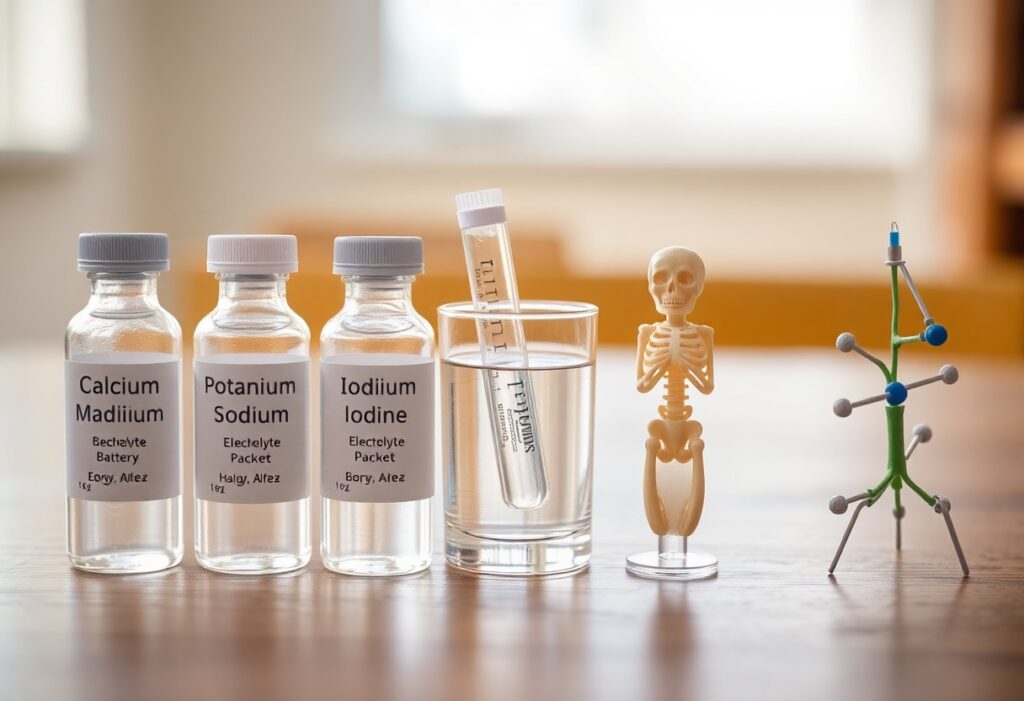

You rely on minerals daily to power cellular energy production, support hormone synthesis and signaling, regulate fluid balance for optimal hydration, stabilize nerve and muscle function, and enable enzyme reactions that keep your metabolism efficient.
Minerals That Drive Cellular Energy
You rely on a handful of minerals to keep mitochondria and metabolic pathways running: magnesium stabilizes ATP, phosphorus supplies phosphate groups, iron enables electron transfer, and trace cofactors like copper, zinc, and selenium fine‑tune enzymes and thyroid signaling. Deficits shift you toward lower power output, slower recovery, and greater perceived effort-athletes and older adults are especially sensitive to small drops in these minerals.
Roles in ATP synthesis (magnesium, phosphorus)
Magnesium forms the active Mg‑ATP complex used by kinases, ATPases, and over 300 enzymatic reactions, while phosphorus provides the high‑energy phosphate bonds in ATP and phosphorylated intermediates. Your daily needs are about 310-420 mg magnesium and 700 mg phosphorus; inadequate intake or low intracellular magnesium blunts ATP turnover and impairs high‑intensity work capacity.
Influence on metabolic rate and fatigue (iron, cofactor minerals)
Iron is central to oxygen delivery (hemoglobin) and to iron-sulfur clusters and heme centers in mitochondrial complexes I-III, so low iron reduces electron transport and VO2. Copper supports complex IV, selenium sustains deiodinases that regulate thyroid-driven metabolic rate, and zinc serves as a cofactor for dehydrogenases-together these minerals determine how efficiently you convert fuels into usable energy.
In practical terms, you should screen for low iron (serum ferritin <30 ng/mL often signals depleted stores) when fatigue or performance drops. Adult RDAs are ~8 mg iron for men and ~18 mg for premenopausal women; trials in iron‑deficient athletes show improved time‑to‑exhaustion after repletion. Also note copper (~0.9 mg/day) and selenium (~55 µg/day) deficits can blunt mitochondrial enzymes and thyroid function, so targeted correction restores metabolic rate and reduces exertional fatigue.
Minerals Regulating Hormonal Balance
Minerals act as enzymatic cofactors and signaling modulators across endocrine pathways, so you depend on trace intakes to keep hormone synthesis, activation, and receptor sensitivity intact. Small deficits can shift metabolic rate, menstrual regularity, libido, and stress resilience. Focused testing and food-first strategies-iodized salt, seafood, nuts, leafy greens-help you correct shortages that commonly manifest as fatigue, mood changes, or altered energy use.
Thyroid function and iodine/selenium
Iodine (WHO recommends ~150 μg/day for adults) provides the substrate for T4/T3 synthesis, while selenium (US RDA ~55 μg/day) is required for selenoprotein deiodinases that convert inactive T4 into active T3. If you lack iodine you risk goiter and low hormone output; low selenium impairs peripheral conversion and increases oxidative stress in the thyroid. Include seaweed, fish, Brazil nuts, and fortified salt when you need to raise intake.
Sex hormones and stress response (zinc, magnesium)
Zinc (RDA ~8-11 mg/day) supports testosterone production, sperm maturation, and aromatase regulation, and magnesium (RDA ~310-420 mg/day) dampens HPA-axis hyperactivity and supports GABAergic tone, so you see effects on both sex steroids and cortisol. Marginal zinc or magnesium status often coincides with low libido, irregular cycles, higher cortisol, and slower recovery from training or stress.
In practice, you’ll find intervention data: trials in zinc-deficient men showed restoration of testosterone with ~30 mg/day zinc supplementation, and several exercise studies using 200-400 mg/day magnesium reported reduced post-exercise cortisol and improved testosterone-to-cortisol ratios. Monitor dose and duration-excess zinc can suppress copper, and high magnesium can cause GI upset-so pair supplementation with dietary changes and, if needed, lab monitoring to track hormonal and mineral responses.
Minerals and Hydration/Electrolyte Balance
Shifts in plasma osmolality (normal 275-295 mOsm/kg) and compartmental ion gradients determine how your body moves and holds water; small changes of a few mOsm/kg alter thirst, ADH release, and urine concentration. In practice, even 1-2% body weight lost as sweat reduces performance, and restoring specific minerals as well as fluid-rather than water alone-returns osmotic balance faster.
Core electrolytes: sodium, potassium, chloride
Sodium (extracellular, 135-145 mmol/L), potassium (plasma 3.5-5.0 mmol/L), and chloride (98-106 mmol/L) set the osmotic and electrical gradients that move water across membranes. If your sodium falls below 135 mmol/L you risk hyponatremia symptoms; potassium above ~5.0 mmol/L raises arrhythmia risk. For athletes, sports drinks with ~20-60 mmol/L sodium and timely potassium replacement offset sweat losses and stabilize performance.
Cellular osmolarity and fluid distribution (magnesium, calcium)
Magnesium and calcium shape intracellular osmolarity by regulating ATP-dependent pumps and signaling pathways: serum Mg typically runs ~0.7-1.1 mmol/L while total serum calcium is ~2.2-2.6 mmol/L (ionized ~1.1-1.3 mmol/L). Magnesium enables ATP binding for the Na+/K+ ATPase, and calcium-triggered signaling alters ion channel conductance and tight-junction permeability, so your cells shift water in response to their activity.
Clinically, low magnesium (under ~0.7 mmol/L) impairs Na+/K+ ATPase, promoting intracellular sodium accumulation and cellular swelling, while high extracellular calcium pulls water toward the vascular space and can cause polyuria and dehydration. In practice, diuretics or prolonged sweating often deplete Mg and K together, so correcting one without the other can leave your cellular fluid distribution abnormal and symptoms like cramps, weakness, or orthostatic intolerance unresolved.
Minerals Supporting Oxygen Transport & Metabolism
Hemoglobin, myoglobin and mitochondrial cytochromes depend on trace metals so your cells can capture and use oxygen efficiently; each hemoglobin molecule binds up to four O2 molecules and carries about 1.34 mL O2 per gram of hemoglobin, so iron shortfalls reduce oxygen delivery, lower endurance and raise perceived exertion. Globally, iron-deficiency anemia affects roughly 1.6 billion people, showing how mineral deficits translate into measurable drops in metabolic capacity and daily energy.
Iron in hemoglobin and energy delivery
Iron drives erythropoiesis and cellular respiration: your red blood cells contain roughly 270 million hemoglobin molecules each, enabling systemic oxygen transport, while myoglobin and mitochondrial heme proteins support muscle oxygen storage and ATP production. If you fall below recommended intake (about 8 mg/day for adult men, 18 mg/day for premenopausal women), you raise the risk of anemia, reduced VO2 and impaired exercise tolerance.
Copper and redox enzyme functions
Copper acts as a cofactor in cytochrome c oxidase (complex IV) and Cu/Zn superoxide dismutase, so your mitochondria maintain efficient electron flow and limit reactive oxygen species. Ceruloplasmin, a copper-containing ferroxidase, oxidizes Fe2+ to Fe3+ to load transferrin, linking copper status to iron mobilization. Adults require about 0.9 mg/day; inadequate copper can mimic iron-deficiency symptoms and hamper aerobic metabolism.
At the molecular level, cytochrome c oxidase contains two copper centers (CuA and CuB) that accept electrons to reduce O2 to H2O, so reduced copper impairs electron transfer and ATP yield. Cu/Zn SOD converts superoxide to hydrogen peroxide, protecting mitochondrial enzymes from oxidative damage. Clinical examples-Menkes disease (systemic copper deficiency) and dietary insufficiency-illustrate how low copper lowers aerobic capacity and disrupts iron handling via impaired ceruloplasmin activity.
Minerals in Nervous and Muscular Signaling
Your nervous and muscular systems rely on mineral-mediated ion fluxes-Ca2+, Mg2+, Na+, and K+-to convert electrical signals into movement and perception. Neurons use voltage-gated Ca2+ channels to trigger neurotransmitter release in milliseconds; skeletal muscle demands sarcoplasmic reticulum Ca2+ release so troponin can permit actin-myosin cross-bridging. Magnesium stabilizes ATP and modulates NMDA receptor gating, while sodium and potassium gradients set membrane excitability. Even small shifts in these ions can produce cramps, arrhythmias, or cognitive slowing.
Calcium and magnesium in neurotransmission and contraction
At synapses, Ca2+ influx through voltage-gated channels raises local free Ca2+ from ~100 nM to tens of μM in microdomains, activating synaptotagmin and triggering vesicle fusion so you perceive stimuli within milliseconds. In skeletal and cardiac muscle, Ca2+ released via ryanodine receptors binds troponin C to enable cross-bridge cycling; magnesium competes with Ca2+ at some sites and is vital for ATP coordination, so low Mg2+ often heightens excitability and predisposes you to spasms.
Sodium-potassium gradients and membrane potential
The Na+/K+ ATPase exports 3 Na+ and imports 2 K+ per ATP, keeping intracellular [Na+] low (~5-15 mM) and [K+] high (~140 mM) and helping maintain a resting potential near −70 mV that you depend on for reliable action potential firing. Rapid Na+ influx causes depolarization while K+ efflux repolarizes the membrane, and pump activity consumes roughly 20-40% of neuronal ATP to sustain those gradients.
Beyond voltage maintenance, the Na+/K+ gradient drives secondary transporters you rely on-SGLT glucose uptake in the intestine and Na+/Ca2+ exchangers in cardiomyocytes-so pump dysfunction alters nutrient uptake and calcium handling. Clinically relevant shifts are small: extracellular K+ rising from 4.0 to ~6.0 mM measurably depolarizes cells and can provoke arrhythmias, while severe hyponatremia (<125 mM) reduces plasma osmolality, risking cerebral edema and seizures; the pump's electrogenic 3:2 exchange also contributes a few millivolts to resting potential and links directly to cellular energy state.
Dietary Sources, Absorption, and Supplementation Guidance
Food sources, enhancers, and inhibitors of uptake
You get iron from red meat (heme iron is absorbed ~15-35%) and non‑heme sources like legumes and spinach (2-10% absorption); pairing non‑heme iron with 50-100 mg vitamin C per meal can double to triple uptake. Phytates in whole grains and legumes, polyphenols in tea/coffee, and high calcium doses blunt iron and zinc absorption. Fermentation, soaking, or sprouting reduces phytates; for magnesium favor leafy greens, nuts, and whole grains while choosing citrate or glycinate forms improves bioavailability when supplementing.
When to test, supplement, and safe dosing considerations
Test if you have persistent fatigue, heavy menses, unexplained muscle cramps, or belong to risk groups (pregnant, vegan, endurance athlete, elderly); order ferritin (deficiency <30 µg/L), serum 25(OH)D for vitamin D, and consider RBC or ionized magnesium if clinical suspicion exists because serum magnesium can be misleading. Avoid exceeding established upper limits-iron 45 mg/day, zinc 40 mg/day, selenium 400 µg/day, supplemental magnesium 350 mg/day-unless supervised by a clinician.
When you need to treat deficiencies, typical regimens are specific: iron therapy often uses 60-100 mg elemental iron every other day to improve absorption and reduce GI side effects; recheck ferritin in 8-12 weeks. Magnesium supplements commonly range 100-400 mg elemental daily (choose glycinate or citrate); zinc 15-30 mg short‑term, selenium 55-200 µg. Take iron away from calcium/antacids, pair iron with vitamin C, and monitor for interactions (high zinc can induce copper deficiency); adjust dosing under medical supervision and repeat labs to guide duration.
To wrap up
With these considerations, understanding the five proven roles minerals play-in producing cellular energy, regulating hormonal signaling, maintaining fluid balance, supporting nerve and muscle function, and enabling enzyme-driven reactions-helps you optimize your diet and supplementation. By prioritizing adequate intake of magnesium, potassium, sodium, calcium, and zinc, you support steady energy, balanced hormones, effective hydration, and overall metabolic resilience.