
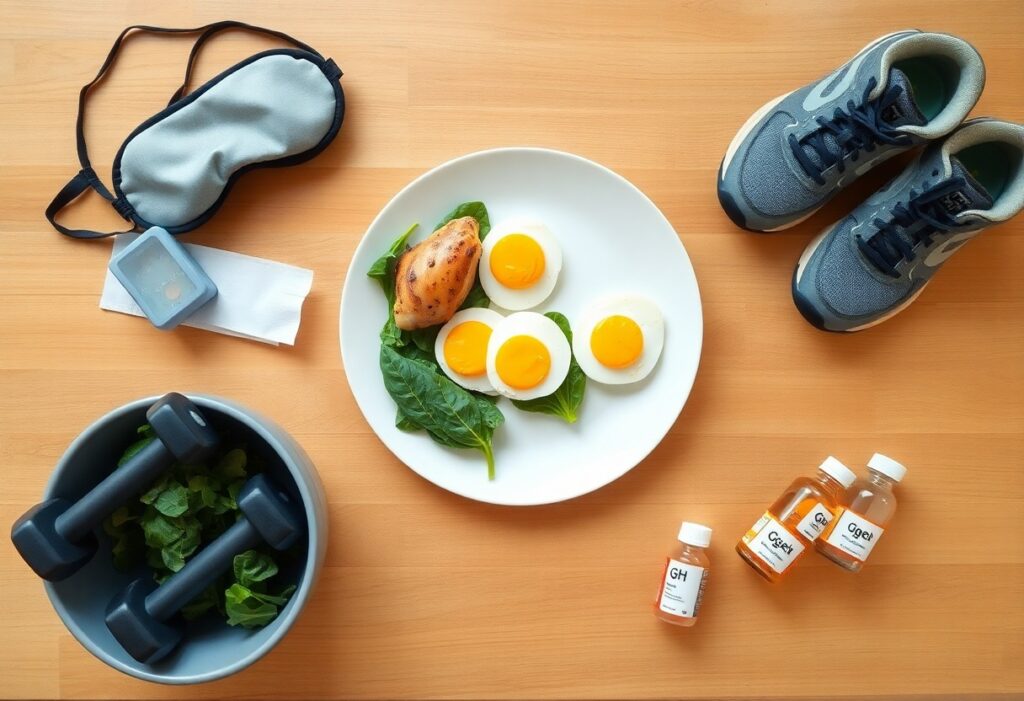

Growth depends on five proven conditions you can optimize to maximize growth hormone secretion and tissue repair: deep restorative sleep, adequate protein and micronutrient intake, resistance exercise, controlled body fat and insulin sensitivity, and effective inflammation and stress management-implement these strategies to enhance recovery and long-term tissue health.
Growth Hormone and Tissue Repair: Physiology & Markers
As you assess repair physiology, GH acts systemically and locally to increase protein synthesis, collagen deposition and satellite cell activation; GH’s plasma half-life is ~20-30 minutes while circulating IGF‑1 (100-300 ng/mL in adults) has a 12-16 hour half-life when bound to IGFBP‑3/ALS, making IGF‑1 a more stable clinical marker. You can monitor repair with serum IGF‑1, IGFBP‑3, PICP (collagen synthesis) and MMP levels to track anabolic versus remodeling phases.
GH secretion patterns, pulsatility and nocturnal peak
When you evaluate GH dynamics, expect high-amplitude pulses every 3-5 hours with the largest surge during slow-wave sleep-roughly 50-75% of daily GH is secreted nocturnally and the main peak occurs within the first 60-90 minutes after sleep onset. Sleep loss can reduce nocturnal secretion by up to 50%, and aging blunts pulse amplitude about 14% per decade, which directly lowers repair capacity and IGF‑1 exposure in tissues.
IGF‑1, receptors and downstream repair pathways
You should track IGF‑1 because it mediates most GH repair effects: hepatically produced endocrine IGF‑1 plus locally produced autocrine/paracrine IGF‑1 bind IGF‑1R, a tyrosine kinase that activates PI3K-Akt-mTOR and MAPK pathways to increase protein synthesis, inhibit FOXO-driven proteolysis, and stimulate cell proliferation; IGFBPs (especially IGFBP‑3) control bioavailability and extend IGF‑1 half‑life, linking serum values to tissue anabolic activity.
Digging deeper, when you stimulate IGF‑1R, autophosphorylation recruits IRS proteins and Shc, launching PI3K which produces PIP3 and activates Akt; Akt then inhibits TSC2 to free mTORC1, increasing S6K1 and 4E‑BP1 activity and boosting translation, while phosphorylating FOXO transcription factors to suppress ubiquitin ligases (atrogin‑1/MuRF1) and reduce proteolysis. Parallel MAPK/ERK signaling drives proliferation and early matrix production. In practical terms, IGF‑1 elevates PICP (procollagen I C‑peptide) and downregulates MMP activity during the anabolic phase; low serum IGF‑1 correlates with slower tendon and fracture healing in cohort studies, so you can use IGF‑1 plus functional markers (PICP, MMPs, satellite‑cell MyoD expression) to profile repair progress.
Condition 1 – Sleep & Circadian Regulation
Slow‑wave sleep, timing and GH surges
About 70-80% of your daily growth hormone is released in pulses tied to slow‑wave sleep, concentrated in the first 90-120 minutes after sleep onset. Deep SWS amplitude predicts GH pulse size, so delayed sleep onset, fragmentation, or circadian misalignment blunts these surges. You’ll get smaller overnight GH peaks when sleep timing shifts later or when nocturnal light exposure fragments SWS.
Sleep hygiene and practical timing strategies
Aim for a consistent 7-9 hour sleep window with sleep onset aligned to your circadian night; shifting bedtimes by more than 1-2 hours reduces SWS. Dim lights 1-2 hours before bed, avoid caffeine within 6 hours, keep the bedroom cool (16-19°C), and get 20-30 minutes of bright morning light to strengthen the circadian signal that times GH release.
Adopt a 30-60 minute wind‑down routine using low lighting and relaxation techniques to deepen SWS at sleep onset. Limit naps to ≤20 minutes before 15:00 to avoid eating into nighttime SWS, lower screen brightness or use blue‑light filters, and swap bright white bulbs for amber/red lamps in the evening. If you do shift work, use timed bright light during your wake period and darkness or blackout strategies before sleep to realign phase and protect GH surges.
Condition 2 – Adequate Protein and Nutrient Support
You should target 1.6-2.2 g/kg/day of protein when repairing tissue or training, distributing 20-40 g of high-quality protein across 3-4 meals to maximize synthesis. Prioritize leucine-rich sources like whey, eggs, and soy to hit the 2.5-3 g leucine threshold per meal. Pair intake with vitamin D, zinc and magnesium to support immune response, collagen formation and sleep-dependent repair.
Essential amino acids, protein distribution and timing
You should hit a per-meal necessary amino acid dose that includes ~2.5-3 g leucine to trigger muscle protein synthesis; older adults typically need 30-40 g protein per meal. Consume 20-40 g whey or mixed proteins within 0-2 hours post-exercise, and take 30-40 g casein or mixed protein before sleep to sustain overnight repair. Space meals every 3-4 hours for steady substrate availability.
Key micronutrients (vitamin D, zinc, magnesium) for repair
You should aim for a 25(OH)D level of 30-50 ng/mL, often achieved with 1,000-4,000 IU D3 daily depending on baseline. Zinc (RDA 8-11 mg) supports collagen and DNA synthesis; short-term 15-30 mg can correct deficiency, but monitor copper if used long-term. Magnesium (RDA 310-420 mg) supports ATP-dependent repair and sleep quality; prefer citrate or glycinate for absorption.
If you are deficient, vitamin D deficiency is associated with slower healing and reduced muscle function; randomized trials in deficient older adults report 10-20% strength gains after supplementation. You should know zinc is a cofactor for collagen cross-linking and wound tensile strength, so clinical protocols often use ~25 mg/day for weeks when deficient. For magnesium, you can split 200-400 mg (glycinate/citrate) in the evening to improve sleep and support nocturnal growth-hormone pulses that aid repair.
Condition 3 – Resistance Exercise and Mechanical Loading
You should prioritize progressive mechanical loading because it amplifies GH pulses and drives local IGF‑1 signaling that supports tissue repair. Heavy compound movements at 70-85% of your 1RM, combined with eccentric emphasis and metabolic stress, produce the largest acute GH responses. Short rest intervals (60-90s) and 3-5 sets per exercise increase stimulus volume while minimizing total session time.
Exercise types that stimulate GH and tissue remodeling
You will get the biggest remodeling signals from multi‑joint, high‑intensity work (squats, deadlifts, presses) and targeted eccentric protocols that raise mechanical tension. Sprint intervals and plyometrics add systemic GH surges and tendon loading, while blood‑flow‑restricted (BFR) low‑load sets mimic high‑load hypertrophy responses. Aim for 6-12 reps for hypertrophy, 3-6 reps for strength phases, or 6-10 × 10-30s sprints for systemic spikes.
- Heavy compound lifts: 3-5 sets, 4-8 reps at 75-90% 1RM – strong GH and neuromuscular signal.
- Eccentric overload: 3-6 sets of 6-10 controlled negatives – promotes sarcomerogenesis and tendon adaptation.
- HIIT/sprints: 6-10 bouts of 10-30s all‑out with 1:3-1:6 work:rest – elicits large systemic GH pulses.
- Plyometrics/ballistic: 2-4 sessions weekly, 50-150 contacts – improves rate of force development and connective tissue resilience.
- Recognizing your training tolerance and history guides whether BFR, heavy loading, or a mixed approach best balances GH response and tissue safety.
| Heavy Compound Lifts | 3-5 sets, 4-8 reps at 75-90% 1RM – max mechanical load, strong GH/IGF response |
| Eccentric Overload | 3-6 sets, 6-10 reps with slow 3-5s negatives – promotes muscle and tendon remodeling |
| HIIT / Sprints | 6-10 × 10-30s all‑out, long rest – systemic GH surges and metabolic stress |
| Plyometrics | 50-150 contacts/session, 2-4x/week – improves connective tissue stiffness and power |
| Blood‑Flow Restriction (BFR) | 20-30% 1RM, 4 sets (30/15/15/15) – low load hypertrophy stimulus with hormonal response |
Recovery, periodization and training dose
You must structure load and recovery so GH‑promoting sessions are followed by 24-72 hours of targeted rest depending on intensity; train muscle groups 2-4 times weekly, rotate heavy and volume weeks, and schedule a deload every 4-8 weeks. Track objective markers like sleep, resting HR, and persistent soreness to adjust volume and intensity promptly.
For example, use a 12‑week block: weeks 1-4 focus hypertrophy (8-12 reps, 3-4 sets, 2-3 sessions/muscle), weeks 5-8 shift to strength (3-6 reps, 4-5 sets, 1-2 heavy sessions/muscle plus 1 maintenance), week 9 as an active deload (~50% volume), and weeks 10-12 as a mixed peak combining heavy lifts and HIIT sprints. Monitor recovery with HRV or 15‑minute morning readiness checks; if HRV drops >10% or soreness limits performance, reduce weekly volume by 20% and prioritize sleep (7-9 hours) and protein intake (1.6-2.2 g/kg/day) to sustain GH‑mediated repair.
Condition 4 – Metabolic Health and Insulin Sensitivity
Your metabolic state strongly shapes GH release and tissue repair: obesity typically reduces spontaneous GH secretion by roughly 50%, while hyperinsulinemia blunts pulse amplitude and frequency. Improving insulin sensitivity restores GH responsiveness and downstream IGF-1 signaling, so strategies that lower fasting insulin and visceral fat directly enhance repair capacity and anabolic signaling during recovery.
Body composition, adiposity and GH suppression
Visceral fat is especially suppressive: higher intra‑abdominal adiposity correlates inversely with peak GH responses and raises free fatty acids that blunt GH pulses. Losing 5-10% body weight-preferentially visceral fat-often increases pulse amplitude and normalizes nocturnal secretion, so targeting central adiposity is a priority for restoring repair hormones.
Dietary strategies (fasting, carb timing) to optimize responses
Short-term fasting and careful carb timing modulate GH and insulin: a 75 g oral glucose load reliably suppresses GH for hours, whereas fasts (e.g., 16-24 hours) increase GH pulse amplitude. You can enhance GH signaling by avoiding high‑GI carbs before sleep and by delaying carbohydrate intake after resistance workouts to preserve post‑exercise GH peaks.
Practical approach: use time‑restricted feeding (8-10 hour eating window or 16:8 fasting) to improve insulin sensitivity, train in the latter part of the fast or fasted morning to amplify GH response, then consume protein immediately post‑session and carbohydrates 30-60 minutes later for glycogen and mTOR activation. Avoid a high‑carb pre‑bed meal; consider a 75 g glucose test as a diagnostic reference for how your carbs acutely affect GH suppression.
Condition 5 – Hormonal Balance and Stress Management
Keep your circadian rhythm intact: growth hormone releases in large pulses during the first 2-3 hours of deep sleep, so prioritize consistent bedtimes and 7-9 hours nightly. Reduce late stimulants (caffeine after 2 PM, evening alcohol) and schedule high-intensity training earlier in the day to protect nocturnal GH. Use short, daily recovery tools (10-20 minutes of breathing, mobility, or HRV biofeedback) to lower sympathetic tone and improve tissue-repair windows.
Cortisol control and autonomic balance
Track your stress physiology: morning serum cortisol typically falls around 6-23 µg/dL, while elevated evening cortisol (>5 µg/dL) disrupts sleep and blunts GH pulses. Improve autonomic balance with 10 minutes of paced breathing at 4-6 breaths/min to boost HRV (RMSSD increases measurably), limit caffeine after mid-afternoon, and use brief mindfulness or cold exposure protocols to shift sympathetic drive without chronically raising cortisol.
Supporting anabolic hormones (testosterone, thyroid) safely
Optimize anabolic hormones with targeted, monitored strategies: aim for total testosterone in men roughly 300-1,000 ng/dL (confirm on two morning samples) and a TSH target around 0.5-2.5 mIU/L when treating hypothyroidism. Prioritize resistance training 2-4×/week, protein 1.6-2.2 g/kg, 7-9 hours sleep, and correct vitamin D (<20 ng/mL deficiency, target 30-50 ng/mL). If considering TRT or thyroid replacement, arrange baseline labs and follow-up monitoring with an endocrinologist.
When you pursue medical optimization, use protocols that lower risk: for hypothyroid replacement, start levothyroxine about 1.6 µg/kg/day and recheck TSH in 6 weeks; for testosterone therapy, monitor hematocrit every 3 months initially and pause or adjust if it exceeds ~54%. Consider fertility-sparing options (hCG or clomiphene) if you want children. Combine these measures with progressive overload training (compound lifts, 3-5 sets, 6-12 reps) and modest weight loss (5-10% if obese) to raise endogenous anabolic drive before escalating to pharmacologic interventions.
To wrap up
Conclusively, to optimize growth hormone-driven tissue repair you need five proven conditions: consistent deep sleep to trigger GH pulses, sufficient protein and calories for substrate, progressive resistance and mechanical loading to stimulate repair, balanced metabolic and endocrine status (insulin, thyroid, sex hormones) to permit anabolic signaling, and effective inflammation control plus key micronutrients to support recovery.