
Over days and weeks your circadian rhythm responds to light cues, and by applying five evidence-based light strategies you can reset your sleep-wake timing naturally; this post shows how timed morning bright light, daytime light exposure, evening dimming and blue-light avoidance, strategic light therapy, and consistent light schedules work together to shift melatonin timing, improve sleep quality, and align your alertness with daytime demands so you can implement practical steps immediately.
How light shapes the circadian clock
Direct retinal input to the suprachiasmatic nucleus (SCN) encodes intensity, spectrum, and duration so you can align sleep-wake timing to the environment; bright morning light (~10,000 lux) shifts phase faster than typical indoor lighting (100-500 lux), while brief evening exposure to blue-rich light (~480 nm) suppresses melatonin and delays sleep. Clinical protocols use 20-60 minutes of timed bright light to move the clock by 30-90 minutes per day, depending on baseline phase and light history.
Key mechanisms: wavelengths, melanopsin, and retinal pathways
Melanopsin-containing intrinsically photosensitive retinal ganglion cells (ipRGCs) peak near 480 nm and drive the strongest non-image-forming responses, but rods and cones modulate ipRGC signaling at low and changing light levels, so you respond differently to steady blue LEDs versus broadband daylight. ipRGCs project to the SCN, the pineal gland pathway that suppresses melatonin, and mood-related nuclei, explaining why spectral composition and intensity both determine physiological outcomes.
Timing effects: phase response curve and sensitivity windows
The human phase response curve (PRC) means light in the evening and early night typically delays your clock, while light in the late night/early morning advances it; in practice, exposing yourself to bright morning light after your core body temperature nadir shifts sleep earlier, whereas screens and room lighting near bedtime can move it later. Controlled light therapy studies report shifts of 0.5-2 hours per day depending on timing and intensity.
More detailed physiology: your core body temperature minimum usually occurs ~1.5-3 hours before habitual wake, creating a high-sensitivity window for phase shifts; light given before that minimum tends to delay, and light after tends to advance. Practical approaches use 10,000 lux for 20-60 minutes or 2,500 lux for longer durations to achieve intended shifts, and timed reduction of blue light in the evening minimizes unintended delays during phase-adjustment programs.
Strategy 1 – Morning bright light to advance your rhythm
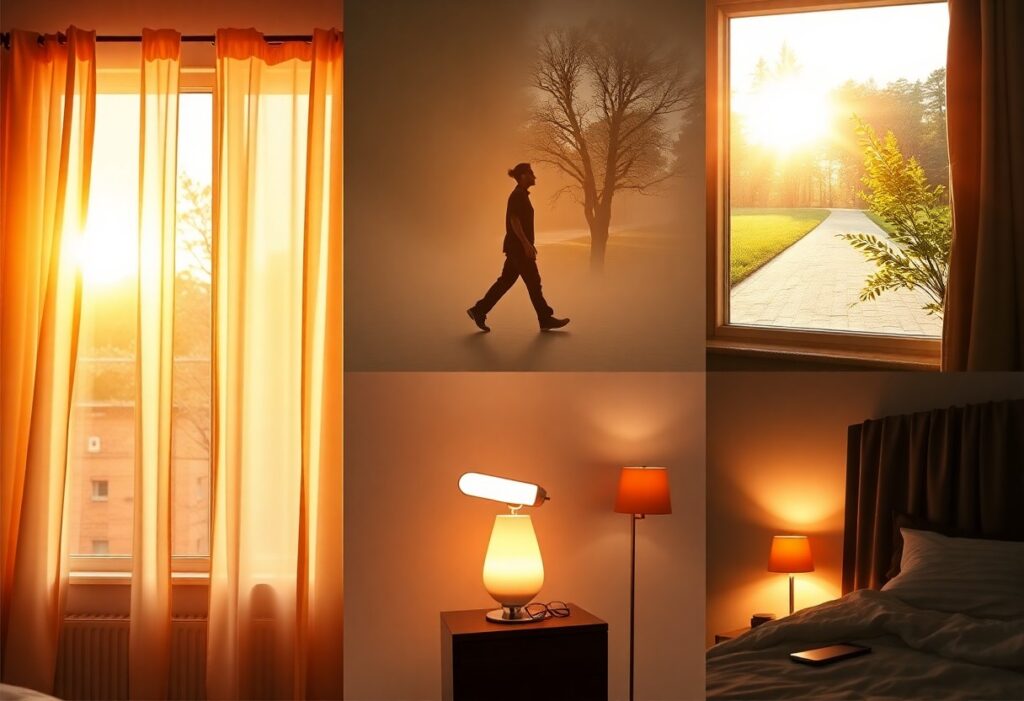
You should get strong light soon after waking to shift your clock earlier: aim for bright outdoor exposure or a 10,000-lux light box within 30-60 minutes of wake time. Clinical protocols show morning light can advance circadian phase by roughly 30-60 minutes per day depending on intensity and timing, helping you fall asleep earlier over several days when combined with consistent wake times and reduced evening light.
Optimal timing, intensity and duration
Target the first 30-90 minutes after waking for the largest phase advance. If outdoors, 20-60 minutes in daylight (5,000-10,000+ lux on a bright day) is effective; indoors use a 10,000-lux box at ~16-24 inches for 20-30 minutes. Lower intensities require longer exposure, and even 2,500-5,000 lux for 60 minutes can help if 10,000 lux isn’t available.
Practical routines: outdoor exposure, light boxes, and consistency
Make it habitual: take a 20-40 minute brisk walk after breakfast, sit by a sunny window with coffee for 20 minutes, or use a 10,000-lux box while you eat or work. Keep wake time within 15-30 minutes daily and position the light box at eye level but off-axis to avoid glare; avoid sunglasses during morning exposure if safe and practical.
If weather, commute, or work prevents outdoor light, schedule a light-box session immediately on rising and couple it with light activity-walking in place or stretching increases retinal blood flow and may enhance phase shifts. For travel east or delayed sleep phase, gradually advance light timing by 15-30 minutes each day; blue-enriched morning spectra are more phase-shifting, but avoid bright or blue light within two hours of your intended bedtime.

Strategy 2 – Reduce evening blue light to anchor sleep
Shift your evening light toward longer wavelengths: short‑wavelength blue light (~460 nm) powerfully suppresses melatonin and shifts circadian phase. One PNAS study found 4 hours of e‑reader use before bed delayed melatonin onset by about 1.5 hours. By cutting blue exposure in the 1-2 hours before sleep you strengthen the biological signal for darkness, making sleep onset earlier and deeper without medication.
Sources to limit: screens, LEDs, and ambient lighting
You should limit phones, tablets, laptops, OLED/LED TVs, cool‑white LED bulbs (>3,500 K) and bright vanity or bathroom lighting. Also watch for indirect sources: streetlights through windows, RGB accent lighting, and motion‑sensor LEDs. Aim to reduce those sources in the hour or two before bed so evening light doesn’t mimic daytime cues that push your clock later.
Tools and habits: filters, warm lighting, and wind‑down rituals
Use software filters (Night Shift, f.lux, built‑in display night modes) scheduled to activate 60-120 minutes pre‑bed, swap household bulbs to warm 2,200-2,700 K options, and consider amber/orange blue‑blocking glasses that filter short wavelengths. Pair these with a consistent wind‑down ritual – paper reading, 10-20 minutes of stretching or journaling, and dimmed lamps – to reinforce the biological transition to sleep.
Practical setup: schedule your devices’ blue‑light filter to turn on at sunset or 90 minutes before bedtime; replace overhead LEDs with “warm” smart bulbs and program them to step down color temperature and brightness over 30-60 minutes; wear amber lenses that block ~90-99% of wavelengths below ~520 nm for the final 60-120 minutes. Small trials and randomized studies show evening blue‑block strategies improve melatonin levels and sleep onset compared with unfiltered evening light.
Strategy 3 – Midday natural light to consolidate daytime wakefulness
Benefits for alertness, mood, and sleep quality
Exposure to strong midday light (around solar noon, roughly 11:00-14:00) helps sustain daytime alertness by increasing retinal illuminance to >1,000 lux compared with typical office levels of 300-500 lux. You’ll notice reduced afternoon sleepiness, improved mood, and more consolidated nighttime sleep when you regularly get 20-30 minutes of daylight; physiological effects include transient cortisol elevation and melatonin suppression that align wake drive with daylight hours.
Easy interventions: breaks, desk placement, and outdoor lunch
Schedule a 15-30 minute outdoor break around midday, move your desk near a south- or east-facing window, and take lunch outside when possible to boost retinal light exposure. If outdoor access is limited, sit by a bright window or use a 2,500-10,000 lux light box for 10-20 minutes during lunch to mimic natural midday intensity and shorten the post-lunch dip.
Practical tweaks help: set calendar reminders for two 15-minute daylight breaks, position your monitor perpendicular to the window to reduce glare while getting light to your eyes, and swap indoor meetings for walking meetings of 1-2 km when feasible. Employers can add outdoor seating or adjustable desks near windows; if you use artificial light, track vertical illuminance at eye level (aim for >1,000 lux) rather than relying on ceiling lux readings alone.
Strategy 4 – Therapeutic light devices and safe use
You should use therapeutic devices with intent: sit within the manufacturer’s recommended distance (commonly 25-60 cm) so you receive the stated lux, keep sessions 20-60 minutes depending on intensity, and position the unit slightly off-axis so your eyes receive light while you can read or work. Blue-enriched spectra (≈460-480 nm) are most effective for melatonin suppression, but can trigger agitation in bipolar disorder or cause eye discomfort, so screen for photosensitizing meds and ocular disease before starting.
Choosing devices: lux, spectrum, timing, and contraindications
Use lux to compare devices: 10,000 lux boxes deliver therapeutic dose in ~20-30 minutes at ~30 cm, while 2,500-5,000 lux devices require longer (60-120 minutes). Prefer devices that specify spectrum; those peaking near 460-480 nm are most biologically active. Time exposure close to your intended phase shift (usually morning to advance, evening to delay). Avoid light therapy if you have bipolar disorder, retinal disease, or take photosensitizing drugs (e.g., tetracyclines, isotretinoin, St. John’s wort) without medical clearance.
Protocol examples for insomnia, seasonal affective disorder, and jet lag
For seasonal affective disorder, use 10,000 lux for 20-30 minutes within 30 minutes of waking daily until symptoms remit; many people see benefit in 1-2 weeks. For delayed sleep phase/insomnia, apply 10,000 lux for 20-45 minutes immediately after waking to advance your clock. For jet lag, seek morning light after eastward travel to advance and evening light after westward travel to delay-apply light for the first 2-3 days at your destination and avoid mistimed light.
Practical examples: if you need to shift wake time from 09:00 to 07:00, advance by 30-60 minutes per day while doing 30 minutes of 10,000 lux each morning; for a transatlantic eastbound flight (−5 to +1 time zones), expose yourself to bright morning light on days 1-3 at destination and avoid evening light, plus consider pre-travel phase-shifts of 1-2 hours per day; always stop and consult a clinician if you develop ocular pain, visual changes, or mood elevation suggestive of mania.
Strategy 5 – Timing light for travel and shift work adaptation
When you face time-zone jumps or rotating shifts, schedule light and darkness as if training a clock: advance by seeking bright morning light and avoiding evening light for eastward moves, delay by getting evening light and blocking morning light for westward moves. A practical rule is to shift your exposure 1-2 hours per day; for a 6-hour change, plan 3-6 days of staged exposure. Use sunglasses, blackout curtains, and portable light boxes to control windows.
Phase-shift planning: strategic exposure and avoidance windows
For eastward advances, expose yourself to 10,000 lux or outdoor sunlight within the first 1-2 hours after your target wake time and avoid bright evening light for at least 3 hours before target sleep. For westward delays, get bright light 2-4 hours before your target bedtime and shield morning light for 2-3 hours after waking. Use incremental 1-2 hour shifts per day and record times to stay consistent.
Combining light with sleep scheduling, naps, and melatonin
Align light with a fixed sleep schedule: set an anchor sleep (same daily start time) and place a 20-30 minute nap before a night shift for alertness or a 90-minute nap for deeper recovery. Consider low-dose melatonin (0.25-3 mg) taken 30-60 minutes before your desired sleep time to help advance sleep onset while using timed light to reinforce the direction of shift. Track timing consistently for 3-7 days.
Example protocols speed adaptation: for a 5-hour eastward shift, wake two hours earlier each day, get 30 minutes of morning outdoor light and take 0.5-1 mg melatonin one hour before the new bedtime; for permanent night shifts, use 30 minutes of 10,000 lux at shift start, take a 90-minute pre-shift nap, wear sunglasses home to block morning light, and consolidate 4-6 hours of daytime sleep with blackout shades to sustain the new phase.
To wrap up
With these considerations you can use targeted light exposure to shift your circadian rhythm, combining morning bright light, daytime natural light, dim evenings, blue-light reduction before bed, and short midday light breaks to reinforce wake-sleep timing. Consistent timing, gradual changes, and environment control let you adapt your sleep patterns safely; consult a specialist if you have persistent sleep disorders or medical conditions.