
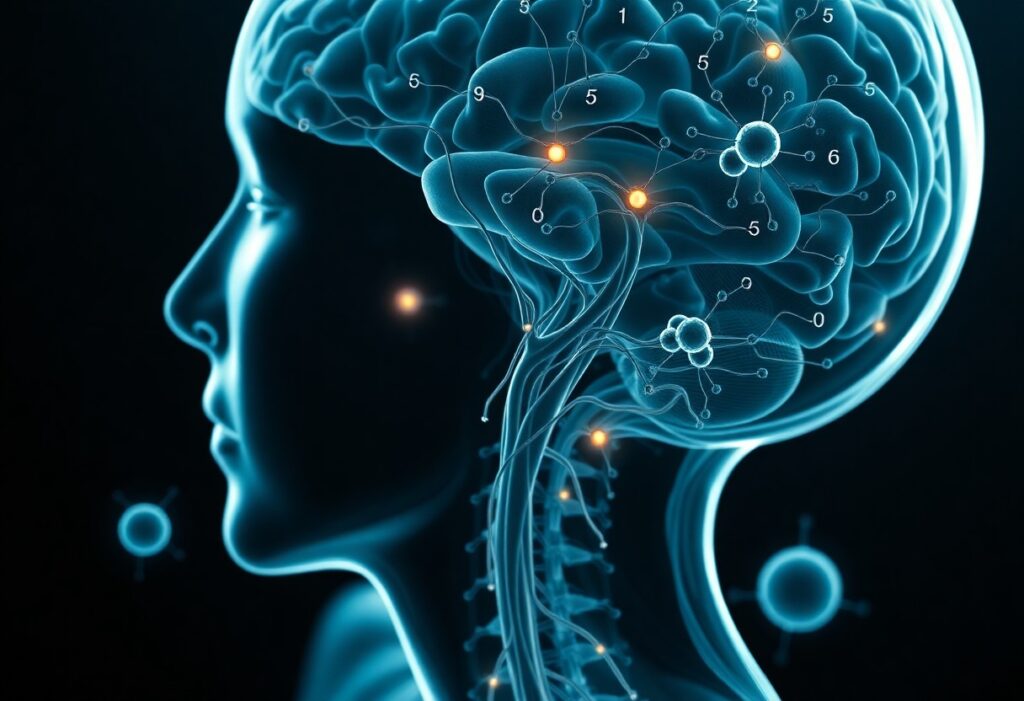

It’s important to recognize how your nervous system governs six interdependent states that enable hormonal balance and cellular repair: restorative sleep, parasympathetic activation, metabolic stability, safe social engagement, calibrated stress responses, and efficient circulation. By cultivating these states through sleep hygiene, breathing, nutrition, movement, and predictable routines you optimize repair pathways, reduce inflammation, and support long-term resilience at cellular and systemic levels.
Nervous-Endocrine Foundations for Repair
Your nervous system times hormonal signals to optimize repair: hypothalamic pulses drive CRH/ACTH and produce cortisol peaks within 20-30 minutes of stress, while the cortisol awakening response lifts levels ~30-50% within 30 minutes of waking. Autonomic balance shifts local blood flow, immune trafficking, and endocrine rhythms, so alterations in sympathetic or vagal tone change cytokine profiles and tissue perfusion that directly influence DNA repair, protein synthesis, and stem-cell niche activity.
Neural regulation of hormonal cascades
Hypothalamic neurons release CRH in discrete bursts that trigger pituitary ACTH within minutes, producing adrenal cortisol with a plasma half-life near 60-90 minutes; sympathetic surges release norepinephrine that modulates adrenal medulla catecholamine output almost immediately. When you experience chronic stress, studies show wound-healing can slow by roughly 20-40%, reflecting altered cortisol pulsatility, disrupted feedback inhibition, and shifted setpoints in HPA and HPG axes.
Cellular repair mechanisms under neural control
Neural inputs govern cell-level repair: vagal cholinergic signaling through α7 nicotinic receptors reduces macrophage TNF release (rodent VNS studies report ~50% TNF reduction), while sympathetic β2 signaling alters stem-cell proliferation and macrophage polarization. You can also modulate local BDNF and NGF release-exercise elevates peripheral BDNF by ~30-50%-which drives satellite cell activation, synaptic remodeling, and angiogenesis at injury sites.
At the molecular level, neural activity regulates mitochondrial biogenesis and autophagy via pathways like PGC-1α and AMPK, so nerve-derived neurotransmitters change cellular energy supply for repair. For example, norepinephrine acting on β-adrenergic receptors shifts hematopoietic progenitor output, and enhanced vagal tone increases IL-10 in models of inflammation, accelerating collagen deposition and functional recovery after tissue injury.
The Six Critical States – Overview
They act as a sequenced program: autonomic downshift, metabolic switching, immune suppression, deep NREM repair, REM remodeling, and active recovery. Their timing dictates hormonal pulses and cellular processes-about 70% of daily growth hormone is released during deep NREM within the first 60-120 minutes of sleep-so when you preserve those windows you restore insulin sensitivity, autophagy activation, and DNA repair more effectively than by isolated interventions.
Enumerated states with concise descriptors
1) Parasympathetic downshift: vagal dominance for low heart rate and reduced cortisol; 2) Metabolic switching: fasting-induced ketogenesis and autophagy; 3) Immune moderation: lowered pro-inflammatory signaling; 4) Deep NREM: slow-wave activity, major GH pulse; 5) REM: synaptic pruning and emotional memory processing; 6) Active recovery: daytime anabolic activity and tissue remodeling.
Hierarchy and temporal coordination
Hierarchy enforces order: you must achieve autonomic downshift and a metabolic switch before deep NREM can deliver its full GH and repair effects, and ultradian cycles (~90-120 minutes) repeat these windows across the night. If the first NREM cycle is fragmented-by alcohol, late caffeine, or noisy sleep-GH pulses and autophagy are blunted, reducing cumulative repair across subsequent cycles.
Practically, you prioritize interventions that protect early-night sequencing: avoid alcohol and heavy late meals, lower ambient light to support melatonin onset, and time fasting windows to promote the metabolic switch before sleep. In trials and cohort data, shift in these temporal patterns correlates with higher inflammatory markers and metabolic dysregulation, so aligning behavior to the hierarchy restores both hormonal rhythm and cellular repair efficiency.
States 1-2: Autonomic Balance & Neuroendocrine Signaling
Sympathetic/parasympathetic equilibrium for repair
You need a dynamic shift from sympathetic activation to parasympathetic restoration to enable tissue repair: sympathetic drive mobilizes energy during stress, then vagal dominance during recovery promotes protein synthesis, lymphatic clearance, and slow-wave sleep-dependent growth hormone release. Objective measures like heart rate variability (RMSSD, HF power) and paced breathing at ~6 breaths/min help you quantify and train that equilibrium to boost nightly repair and reduce inflammatory signaling.
- Use HRV (RMSSD, HF) to track vagal recovery after stressors and workouts.
- Behavioral tools-paced breathing, cold exposure, and short mindfulness sessions-can increase parasympathetic tone within minutes.
- Any prolonged sympathetic predominance reduces nocturnal GH pulses, delays cellular autophagy, and impairs tissue remodeling.
HPA axis, pituitary factors and trophic signaling
Your HPA axis timing governs cortisol rhythm, while pituitary hormones (ACTH, GH, prolactin) and downstream trophic factors (IGF‑1, BDNF) drive cellular maintenance. A healthy cortisol awakening response (typically a 50-100% rise in the first 30 minutes) and a steep diurnal decline support immune regulation; conversely, a flattened slope correlates with slower wound healing and reduced muscle protein synthesis.
- Assess diurnal cortisol profiles and IGF‑1/BDNF to identify neuroendocrine disruptions that limit repair.
- Intervene with sleep consolidation, morning light exposure, and timed protein intake to restore hormonal rhythms.
- Any blunting of the cortisol rhythm or suppression of nocturnal GH predicts poorer recovery outcomes and metabolic dysregulation.
You can trace mechanisms: hypothalamic CRH pulses drive pituitary ACTH, which prompts adrenal cortisol release and negative feedback; GHRH and somatostatin gate pituitary GH pulses that produce most daily GH during slow-wave sleep (about 60-80% at night), and hepatic IGF‑1 mediates anabolic effects. Clinical populations-shift workers or chronic caregivers-often show flattened cortisol slopes and suppressed nocturnal GH/IGF‑1, which links to slower tissue repair and increased inflammation.
- Key biomarkers: diurnal cortisol curve, ACTH dynamics, nocturnal GH peaks, serum IGF‑1 and peripheral BDNF levels.
- Practical strategies: consolidate sleep timing, preserve slow‑wave sleep, apply zeitgebers (light/exercise timing), and use targeted nutritional support for nightly anabolic signaling.
- Any sustained mismatch between HPA output and pituitary trophic signaling undermines mitochondrial renewal, immune resolution, and long‑term cellular resilience.
States 3-4: Inflammatory Resolution & Metabolic Support
Central and peripheral immune modulation
You steer both central and peripheral immunity toward resolution by shifting microglia from pro‑inflammatory (M1‑like) to repair‑oriented phenotypes and expanding regulatory T cells in the periphery. Vagal efferent signaling engages the α7 nicotinic receptor on macrophages to blunt TNF‑α, while IL‑10 and TGF‑β rise during the 24-72 hour resolution window. You can also leverage omega‑3-derived resolvins (RvD1, RvE1) to accelerate clearance of neutrophils and restore tissue homeostasis.
Mitochondrial function, glucose and lipid provision
You must protect and fuel mitochondria so ATP supply meets repair demand: a single glucose molecule yields ~30-36 ATP via oxidative phosphorylation, neurons rely on GLUT1 while muscle and adipose recruit GLUT4, and fatty acids enter mitochondria via CPT1 for β‑oxidation. Controlled ROS from complexes I/III signals mitophagy (PINK1/Parkin) and biogenesis, but excess ROS impairs membrane repair and hormone synthesis.
You accelerate mitochondrial capacity with targeted interventions: endurance training upregulates PGC‑1α and can increase citrate synthase activity by ~20-40% over 6-12 weeks, intermittent fasting or ketogenic shifts raise β‑hydroxybutyrate which supports ATP and acts as a signaling metabolite, and NAD+ boosters (NR/niacin) plus AMPK activation improve respiratory efficiency and mitophagy, optimizing substrate flexibility between glucose and lipids during repair.

States 5-6: Sleep/Circadian Alignment & Neural Plasticity
Sleep architecture, melatonin and clock genes
Your slow-wave sleep (N3) drives growth hormone pulses and clears metabolic byproducts via glymphatic flow, while REM supports procedural consolidation; normal architecture cycles every ~90 minutes across 4-6 cycles nightly. Dim-light melatonin onset (DLMO) typically appears ~2 hours before habitual bedtime and synchronizes peripheral clocks through PER, CLOCK and BMAL1 gene expression. When circadian misalignment occurs-common in shift workers who show ~1.4× higher metabolic syndrome risk-your hormone rhythms, sleep staging, and cellular repair efficiency all degrade.
BDNF, synaptogenesis and activity-dependent repair
BDNF elevates with aerobic exercise, sleep and learning, promoting synaptogenesis particularly in the hippocampus and motor cortex; acute exercise often raises peripheral BDNF by ~20-40%. When you pair targeted practice with sufficient sleep, activity-dependent LTP consolidates new synapses and prunes weaker ones, enabling functional recovery after injury and improving skill retention across days and weeks.
At the molecular level, BDNF binds TrkB receptors to activate PI3K-Akt, MAPK/ERK and mTOR pathways, which drive dendritic spine growth, protein synthesis and mitochondrial support for long-term synaptic consolidation. Clinically relevant examples include pairing 20-30 minutes of moderate-to-high intensity aerobic exercise immediately before motor training to boost retention in stroke rehab, and using extended sleep or naps to enhance hippocampal-dependent memory consolidation; randomized trials show improved motor learning retention when exercise precedes practice. Pharmacologic and lifestyle interventions-SSRIs, omega-3s, vitamin D, consistent sleep timing-modulate BDNF expression over days to weeks, so you should time rehabilitative training to coincide with windows of heightened plasticity (post-exercise, during early sleep) to maximize synaptogenesis and activity-dependent repair.
Translational Strategies and Clinical Applications
Behavioral, lifestyle and rehabilitative interventions
You should prioritize structured interventions that drive plasticity: 30 minutes of moderate aerobic activity 3-5 times weekly for 6-12 weeks, HRV biofeedback 10-20 minutes daily to boost autonomic balance, and strict sleep consolidation targeting 7-9 hours. Complement with graded motor imagery or mirror therapy for focal pain, vestibular rehab 2-3 sessions/week for 4-8 weeks when balance is impaired, and CBT or acceptance-based therapies to reduce threat appraisal and improve adherence.
Pharmacologic, nutraceutical and device-based supports
You can use targeted agents and devices to amplify repair: SSRIs/SNRIs or gabapentinoids for central sensitization while monitoring response over 6-12 weeks; omega-3 fatty acids (1-3 g/day) and vitamin D to modulate inflammation; and device options such as rTMS (20-30 minute sessions, 5 days/week × 4-6 weeks), tDCS (1-2 mA, ~20 minutes), or transcutaneous VNS (15-30 minutes/day) for neuromodulation adjuncts.
You should individualize selection by mechanism and biomarkers: for example, aim to correct 25(OH)D to >30 ng/mL, consider omega-3 when triglycerides or inflammatory markers are elevated, and reserve invasive VNS or spinal stimulation for refractory cases after multimodal failure. Combine pharmacologic agents with neuromodulation to target BDNF and synaptic plasticity, track outcomes with symptom scales and HRV, and coordinate dosing and device protocols with treating clinicians to avoid interactions and optimize timing.
Final Words
Conclusively, to support hormonal and cellular repair you must prioritize six nervous-system states-deep restorative sleep, regulated stress response, balanced autonomic tone, controlled inflammation, optimized neuroendocrine signaling, and consistent metabolic support-so your tissues can repair, hormones reestablish equilibrium, and cellular processes normalize; integrate sleep hygiene, stress management, targeted nutrition, and medical guidance to maintain these states and maximize recovery.