
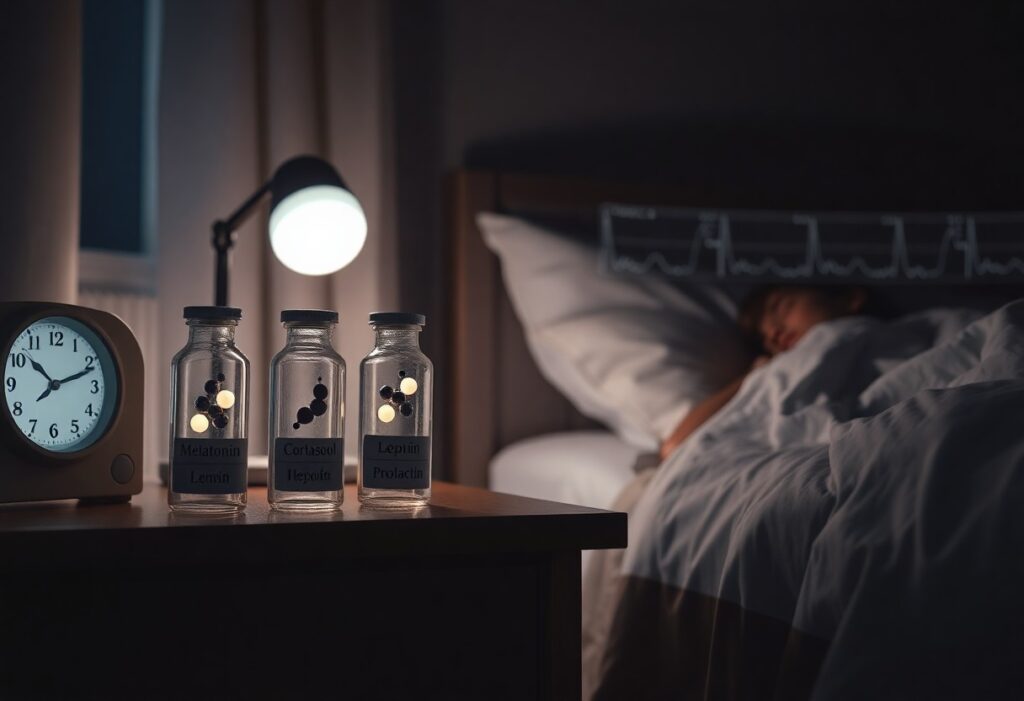

Cycles of deep sleep orchestrate melatonin, growth hormone, cortisol, leptin, ghrelin and prolactin to drive recovery, metabolic regulation, appetite control, stress resilience and reproductive and immune function; understanding these connections lets you adjust your sleep timing and habits to enhance repair, weight management, mood and overall hormonal balance.
Melatonin
Role – circadian timing and sleep initiation
Melatonin signals night to your brain: dim light melatonin onset (DLMO) usually occurs about 1.5-2 hours before your habitual bedtime, produced by the pineal gland and peaking overnight; typical nocturnal serum levels range roughly 10-80 pg/mL. You experience increased sleep propensity as melatonin rises, which helps time sleep onset and coordinates peripheral clocks across tissues.
Deep-sleep link – secretion patterns, timing, and therapeutic implications
Secretion peaks around 2-4 a.m. and is suppressed within minutes by light exposure, so melatonin primarily shifts your circadian phase rather than directly generating N3 slow-wave sleep; clinically, low physiological doses (0.3-0.5 mg) given 1-2 hours before DLMO can advance sleep timing for delayed sleep-phase and jet lag, whereas higher doses (3-5 mg) are often used for symptomatic sleep initiation but carry a higher risk of morning grogginess.
More granular evidence shows that timing is everything: giving melatonin in the early evening (before or around DLMO) produces phase advances of 30-90 minutes in many people, while administration at the wrong circadian phase can blunt benefit or produce delays. You’ll get better results when combining melatonin with light therapy-bright morning light after an advance strengthens the shift, and avoiding evening light preserves endogenous secretion. Older adults typically have substantially lower nocturnal melatonin (sometimes 30-50% less), and multiple trials report improved sleep latency and efficiency with low-dose, timed melatonin in that group. Note interactions matter too: melatonin can potentiate sedatives and interact with anticoagulants and CYP1A2-metabolized drugs, so dose timing and medical context should guide your use.
Growth Hormone (GH)
GH is secreted in strong, pulsatile bursts by the anterior pituitary, with roughly 60-70% of daily release occurring during early-night slow-wave sleep (SWS); pulses are largest during puberty and decline markedly with age, lowering peak amplitude and frequency so your overnight recovery and anabolic signaling change as you get older.
Role – tissue repair, growth, metabolic regulation
GH drives liver IGF-1 production, stimulates protein synthesis, promotes lipolysis and bone growth, and modulates glucose handling, so when your GH is optimal you recover faster from exercise, build lean mass more efficiently, and maintain bone density; pediatric GH deficiency causes short stature, while adult deficiency increases fat mass and reduces strength and bone mineral density.
Deep-sleep link – major slow-wave release pulses and effects of SWS loss
Major GH pulses align with stage N3 SWS, typically in the first 60-90 minutes after sleep onset and during subsequent SWS episodes; suppressing SWS (for instance with sleep fragmentation, shift work, or some hypnotics) can cut nocturnal GH release by about half, impairing muscle repair, reducing IGF-1 signaling, and worsening insulin sensitivity in your daily metabolism.
SWS promotes GH by increasing GHRH drive and lowering somatostatin tone, so when SWS is reduced you experience fewer and smaller GH pulses; clinical examples include obstructive sleep apnea and benzodiazepine use, both linked to blunted nocturnal GH and lower IGF-1, whereas high-intensity daytime exercise and optimized sleep architecture help restore pulse amplitude and improve your anabolic and metabolic outcomes.
Cortisol
You produce cortisol in the adrenal cortex; it mobilizes glucose, modulates inflammation, and shapes sleep-wake arousal. Nighttime levels drop during restorative sleep and then rise sharply after you wake, coordinating energy availability and alertness while interacting with growth hormone and autonomic tone.
Role – stress response and circadian arousal
Cortisol drives the HPA stress response and the circadian wake drive by binding glucocorticoid receptors in brain and peripheral tissues, increasing gluconeogenesis, blood pressure, and vigilance. The cortisol awakening response peaks about 30-45 minutes after waking, typically rising roughly 50-75%, to help you transition quickly into daytime activity and cognition.
Deep-sleep link – nocturnal suppression, morning surge, and consequences of disrupted SWS
During slow-wave sleep HPA output is suppressed so nocturnal cortisol stays low and the morning surge remains robust; when SWS is fragmented or reduced, nocturnal cortisol can stay elevated, the diurnal slope flattens, and you experience impaired glucose regulation, higher blood pressure, and worse cognitive recovery.
Evidence from controlled experiments confirms the link: restricting sleep to 4 hours per night for multiple nights elevated evening cortisol and worsened glucose tolerance (Leproult & Van Cauter), and selective suppression of SWS for three nights lowered insulin sensitivity by about 25% while raising nocturnal cortisol. In real-world terms, chronic insomnia or shift work often mirrors these changes, tying disrupted SWS to metabolic and cardiovascular risk as well as daytime fatigue and cognitive deficits.
Leptin
When your fat cells secrete leptin they communicate energy stores to the brain, so circulating leptin generally rises with adiposity. You can have high leptin yet poor satiety signaling due to leptin resistance, which helps explain why excess body fat often coexists with persistent hunger and reduced metabolic adaptation.
Role – satiety signaling and energy balance
Leptin acts on hypothalamic circuits to suppress NPY/AgRP and activate POMC neurons, cutting appetite and increasing energy expenditure. You see the hormone’s power in congenital leptin deficiency: replacement therapy reverses severe hyperphagia and rapid weight gain within weeks, showing leptin’s role in setting your long-term energy balance.
Deep-sleep link – SWS support for leptin levels and appetite regulation
SWS, concentrated in the first half of the night, helps preserve nocturnal leptin secretion; experimental sleep restriction to 4 hours/night for two nights produced about an 18% drop in leptin and a concurrent rise in ghrelin, which led subjects to report greater hunger and choose more carbohydrate-rich snacks.
Mechanistically, SWS lowers sympathetic activity and stabilizes endocrine pulses that favor leptin release, so when your SWS is fragmented or reduced the nocturnal leptin amplitude blunts and appetite signals shift. You can reverse acute changes within days by restoring sleep duration and consolidation; clinical lab studies show leptin levels and ad libitum caloric intake move toward baseline after sleep recovery, though chronic SWS loss may sustain appetite dysregulation.
Ghrelin
Role – hunger signaling and glucose metabolism
Ghrelin, produced mainly in your stomach, signals hunger to the hypothalamus and peaks before meals. It stimulates appetite and gastric motility, promotes growth hormone release, and influences glucose metabolism by reducing insulin sensitivity. You’ll typically feel stronger hunger cues as ghrelin rises during fasting and drops after eating, which shapes meal timing and portion size.
Deep-sleep link – reduced deep sleep raises ghrelin, increasing appetite and metabolic risk
When your slow‑wave (deep) sleep is reduced, ghrelin levels tend to increase-especially with sleep restricted to 4-5 hours-making you feel hungrier and more likely to choose calorie‑dense foods. Clinical studies associate fragmented or curtailed SWS with higher daytime ghrelin, greater caloric intake, weight gain, and worsened glucose tolerance.
In experimental trials, short-term sleep restriction (two to several nights at 4-5 hours) increased ghrelin and subjective hunger while lowering leptin, driving average daily caloric intake up by roughly 200-300 kcal in many cohorts; the Spiegel et al. sleep-deprivation studies exemplify this pattern. Mechanistically, reduced SWS appears to disinhibit hypothalamic ghrelin release and alter autonomic and HPA axis activity, so you experience stronger hunger signals and poorer postprandial glucose handling. Practical steps that boost your SWS-consistent sleep schedule, evening cooling, regular aerobic exercise, and limiting alcohol and late caffeine-can blunt ghrelin spikes and reduce metabolic risk, although individual responses vary by age, sex, and baseline sleep debt.
Testosterone
Your nighttime testosterone production supports sexual function, muscle maintenance, and metabolic regulation. Produced mainly by Leydig cells in the testes (with smaller ovarian and adrenal contributions), testosterone rises during sleep and peaks in the early morning. When deep sleep is reduced or fragmented, your daytime levels fall, which can lower libido, blunt muscle recovery, and sap energy and mood.
Role – reproductive function, muscle maintenance, metabolic health
Testosterone drives spermatogenesis, libido, and erectile function while promoting muscle protein synthesis, bone density, and favorable fat distribution; normal adult male total testosterone is roughly 300-1,000 ng/dL and values below ~300 ng/dL are associated with decreased strength and increased adiposity. If your levels decline, you’ll often notice reduced muscle mass, higher body fat, impaired glucose handling, and lower sexual drive.
Deep-sleep link – nocturnal SWS peaks drive testosterone production; impact of fragmented deep sleep
Slow-wave sleep (SWS) predominates in the first 3-4 hours of the night and aligns with nocturnal rises in luteinizing hormone and testosterone; fragmented deep sleep blunts those nocturnal pulses and lowers morning testosterone-one controlled study found that restricting sleep to 5 hours per night for one week reduced daytime testosterone by about 10-15% in young men.
Physiologically, SWS enhances hypothalamic GnRH/LH pulse amplitude so Leydig cells increase testosterone secretion in the early night, synchronizing with ~90-minute ultradian sleep cycles; when you experience frequent arousals, apnea, or age-related SWS loss, LH pulse amplitude falls and the nocturnal surge attenuates. Clinically, men with obstructive sleep apnea often show lower morning testosterone and impaired libido-treatment (e.g., CPAP) can improve symptoms, though recovery of serum testosterone varies and may depend on weight, age, and baseline endocrine status.
To wrap up
Hence deep sleep orchestrates melatonin, cortisol, growth hormone, prolactin, leptin and ghrelin to restore your metabolism, immune function, tissue repair and appetite balance; disruptions blunt growth hormone release, elevate cortisol, and skew leptin/ghrelin signals, increasing metabolic and cognitive risks. Prioritize consistent deep-sleep habits so you preserve hormonal rhythms that support recovery, energy regulation and long-term health.