
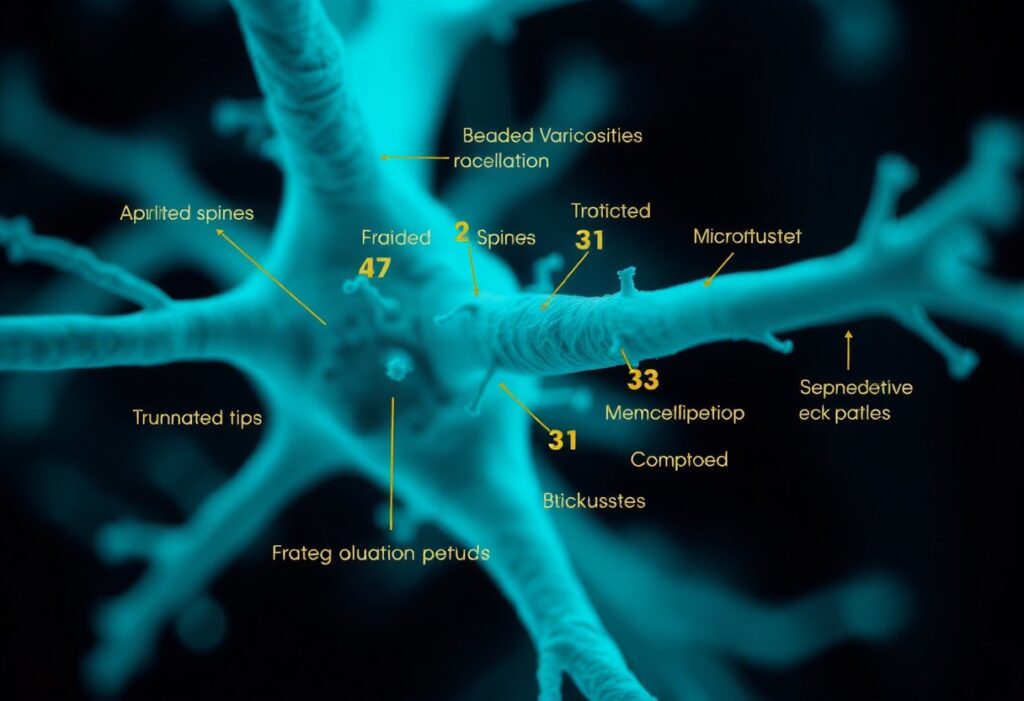

Most brains depend on dendrites to integrate signals, but nine hidden disruptions-oxidative stress, chronic inflammation, metabolic decline, toxic protein buildup, impaired calcium signaling, reduced neurotrophic support, synaptic pruning errors, sleep loss, and vascular insufficiency-gradually weaken your neural communication; this post identifies each mechanism, explains how it alters dendritic structure and function, and outlines evidence-based steps you can take to protect connectivity over time.
Structural vulnerability
Your dendritic architecture is a mechanical and functional scaffold that degrades with cumulative insults: spine density can fall by 20-50% in neurodegenerative and stress models, while total dendritic length often shortens by 10-30% with aging or disease. These structural changes reduce convergent input, lower synaptic integration capacity, and shift network excitability, so the subtle loss of branches and spines translates directly into measurable declines in information processing.
Dendritic spine loss and synapse elimination
You lose postsynaptic sites when spines retract or are pruned-data show synapse density declines of roughly 20-45% in early Alzheimer’s and similar ranges in chronic stress models. Microglial complement-mediated pruning (C1q/C3) and amyloid-β-induced spine destabilization in APP transgenic mice are concrete examples; functionally, fewer spines mean diminished EPSP summation, weakened LTP induction, and deficits in memory encoding.
Dendritic arbor simplification and branching loss
Your dendritic tree becomes less complex under chronic stress, aging, and tau pathology: rodent chronic stress models reveal CA3 apical dendrite retraction around 20-30%, while human prefrontal neurons show 10-30% reductions in branching with age and AD. Loss of higher-order branches cuts the receptive field for synaptic input, alters coincidence detection, and reduces computational repertoire at the single-neuron level.
More granular metrics reveal the mechanisms: Sholl analyses often detect 15-25% fewer intersections at distal radii, branch-point counts drop, and total path length shortens. In APP/PS1 mouse models, dendrites near plaques show local simplification; with tau hyperphosphorylation you get microtubule destabilization that precedes visible retraction. For you this means reduced temporal summation, lower dendritic spike probability, and impaired network synchrony.
Local synaptic machinery failures
You rely on localized protein synthesis and scaffolding to keep synaptic signaling precise; when that machinery fails, synaptic strength erodes. Polyribosomes appear in up to 20% of stimulated spines during LTP, but disruption of transport, ribosomal integrity, or local translation factors reduces on-site supply of proteins like CaMKIIα and actin-regulating factors, limiting potentiation and accelerating spine shrinkage.
Impaired mRNA transport and local protein synthesis
You experience deficits when mRNA-binding proteins (FMRP, Staufen, ZBP1) and kinesin motors fail to deliver transcripts such as β-actin, Camk2a and Arc into dendrites; Fragile X loss of FMRP or TDP-43 aggregation in ALS mislocalizes mRNAs, alters local translation profiles, and produces malformed spines with measurable plasticity and behavioral impairments.
Receptor trafficking and synaptic receptor dysregulation
You depend on dynamic receptor trafficking-AMPAR insertion/removal and NMDAR composition-to set synaptic gain; disruptions in GluA1 phosphorylation (Ser831/845), endocytic machinery, or scaffolds (PSD-95, GRIP, PICK1) shift receptor balance, lowering AMPAR surface expression and reducing EPSC amplitude, a pattern accelerated by Aβ oligomers and aging-related signaling changes.
Mechanistically, LTP recruits AMPARs to synapses, boosting AMPAR-mediated EPSCs by roughly 30-50%; conversely, Aβ oligomers at nanomolar concentrations can trigger calcineurin-dependent AMPAR endocytosis within minutes, while altered Rab5/Rab11 endosomal sorting or tau-mediated kinesin disruption stalls receptor recycling, producing sustained deficits in your synaptic transmission.
Ionic balance and electrical signalling breakdown
When your ion gradients erode, dendritic electrical signalling falters: intracellular K+ (~140 mM), Na+ (~5-15 mM) and resting Ca2+ (~100 nM) are tightly maintained, and even modest declines in ATP or transporter function tilt membrane potential, broaden EPSPs and reduce spike fidelity. You’ll see synaptic currents become noisier, backpropagating action potentials fail more often, and temporal precision drop-phenotypes linked to cognitive decline in ageing and disease models.
Calcium dyshomeostasis and buffering failure
You rely on fast Ca2+ clearance to encode timing and plasticity; buffering proteins like calbindin often fall (commonly reported reductions near ~40% in aged hippocampus) and organelle uptake slows, so resting Ca2+ can rise two- to threefold and transients reach 1-5 µM longer than normal. These shifts favor maladaptive kinase activation, protease activity and impaired LTP, converting brief signals into chronic, disruptive calcium loads.
Ion-channel remodeling and altered dendritic excitability
Channel expression and distribution change with age and pathology: A-type Kv4 currents often decrease while HCN1-mediated Ih can increase, shifting resonance and lowering dendritic input resistance; experiments show Ih upregulation can reduce input resistance by ~20-30%, blunting EPSP amplitude and gating dendritic spike initiation. You’ll experience reduced synaptic gain, altered integration windows and disrupted spike-timing-dependent plasticity as a result.
Mechanistically, phosphorylation, trafficking and transcriptional shifts drive the remodeling: inflammatory cytokines and amyloid-β modify Kv, Nav and HCN channel phosphorylation, increasing persistent Na+ or reducing A-type K+ conductance, which raises dendritic excitability and spike probability. In mouse models of neurodegeneration these channel changes correlate with 30-50% impairments in LTP and abnormal place-cell firing, linking molecular remodeling to circuit-level information loss you depend on.
Metabolic and redox stress
When metabolic and redox balance shifts, your dendrites lose signaling fidelity: the brain consumes roughly 20% of your body’s oxygen and glucose despite being ~2% of mass, so modest ATP or NAD+ drops impair ion pumps, vesicle cycling and calcium buffering. In aging and disease you see depleted NAD+ pools, altered glutathione ratios and rising ROS that together suppress synaptic plasticity and drive spine pruning.
Mitochondrial dysfunction and ATP deficit
Local mitochondrial failure in dendrites cuts off ATP supply and calcium buffering, undermining Na+/K+ ATPase and synaptic vesicle recycling; in Alzheimer’s and Parkinson’s models, complex I/IV defects or impaired mitochondrial trafficking reduce ATP locally and correlate with spine loss. You depend on motile mitochondria to pause at active spines, so disruptions in Miro/Milton transport or fission-fusion balance quickly compromise transmission and LTP.
Oxidative damage to membranes and cytoskeleton
ROS-driven lipid peroxidation produces 4‑HNE and MDA that adduct membrane proteins and cytoskeletal elements, stiffening membranes and destabilizing actin/tubulin networks; you observe dendritic beading, slowed cargo transport and altered receptor mobility as a consequence. Elevated 4‑HNE-tubulin and protein carbonylation found in aged and AD brains link oxidative modification directly to synaptic weakening.
Beyond adduct formation, oxidative products alter ion channels (NMDA/AMPA), reducing conductance and gating fidelity, and oxidize spectrin to promote calpain-mediated cleavage, producing the beaded dendritic morphology seen after oxidative insults. Clinically, increased malondialdehyde and protein carbonyl levels in AD postmortem tissue and CSF tie these biochemical markers to the morphological dendritic decline you study.
Glia- and immune-mediated disruption
You’ll see that age, systemic inflammation and local immune signaling rewire dendritic landscapes: microglia upregulate complement factors C1q/C3, cytokines such as IL-1β and TNF-α rise, and peripheral immune cells infiltrate weakened barriers. This combination accelerates synapse elimination, depresses spine density, and shifts excitatory/inhibitory balance, contributing to subtle cognitive decline long before overt pathology appears.
Microglial overactivation and complement-mediated pruning
You should note microglia use complement-C1q tags weak synapses, C3 opsonizes them and microglia bearing CR3 phagocytose spines. In development this sculpts circuits, but in aging and Alzheimer models excessive pruning cuts spine density by roughly 20-40%. Blocking C1q or C3 in mice preserves synapses and rescues performance on memory tests, showing this pathway directly weakens dendritic connectivity.
Astrocyte dysfunction and loss of metabolic/neurotransmitter support
You rely on astrocytes for glutamate clearance (EAAT2/GLT‑1 removes ~90% of synaptic glutamate), K+ buffering via Kir4.1 and metabolic support through lactate shuttling (MCTs). When GLT‑1 expression falls-often 30-50% in aged or diseased tissue-you face glutamate spillover, NMDA overactivation, impaired LTP and greater metabolic failure during high-frequency firing.
You can see this in disease: in ALS and Alzheimer’s models GLT‑1 loss correlates with early synapse failure, while reactive “A1” astrocytes release complement C3 and inflammatory mediators that further silence synapses. Astrocytic glycogen and lactate normally sustain bursts of neuronal firing for several minutes; when metabolic coupling falters, recovery after high-frequency activity slows and your dendrites lose resilience. Pharmacologic GLT‑1 enhancers (e.g., ceftriaxone in preclinical studies) restore uptake and improve synaptic function, demonstrating causal impact.
External and intrinsic risk modifiers
When you layer external exposures and internal vulnerabilities on top of age-related changes, dendritic integrity deteriorates faster: systemic inflammation from metabolic disease, repeated cortisol surges from chronic stress, and lifelong toxin exposure all accelerate spine loss and synaptic weakening, and epidemiological data link type 2 diabetes to roughly double the risk of cognitive decline, showing how modifiable and genetic modifiers interact to amplify neural communication failure.
Chronic stress, sleep loss and systemic metabolic disease
If you endure repeated stress or sleep restriction, cortisol spikes and disrupted sleep-dependent consolidation reduce hippocampal spine density and impair LTP-rodent chronic restraint models show ~20-30% CA3 dendritic retraction; concurrently, insulin resistance and hyperglycemia from type 2 diabetes drive oxidative damage and AGE crosslinking that weaken dendrites, so poor sleep, persistent stress, and metabolic syndrome synergize to erode circuit resilience.
Environmental toxins, protein aggregates and genetic risk variants
You face added risk when environmental neurotoxins (lead, organophosphates, fine particulates) converge with endogenous proteopathic species and risk alleles: amyloid‑β oligomers and mislocalized tau trigger rapid spine loss, while APOE4 and TREM2 variants alter synaptic repair and microglial pruning, increasing vulnerability to dendritic pruning and synaptic failure even before overt cell death.
Diving deeper, Aβ oligomers bind NMDA/α7‑nACh receptors and drive AMPA receptor internalization, producing 30-50% spine loss in acute slice experiments, whereas tau phosphorylation and somatodendritic mislocalization disrupt microtubule transport and postsynaptic scaffolds; concurrently, chronic low‑level exposure to PM2.5 or organophosphates elevates ROS and neuroinflammation, and in carriers of APOE4 you see amplified synaptic dysfunction and reduced capacity for dendritic remodeling after injury.
To wrap up
Summing up, the nine hidden disruptions reveal how inflammation, metabolic stress, toxin exposure, sleep loss, chronic stress, synaptic pruning imbalance, vascular decline, impaired clearance, and aging cumulatively degrade dendritic structure and slow neural signaling; by recognizing these factors you can prioritize sleep, manage stress, maintain metabolic health, reduce toxin exposure, and support vascular and immune function to preserve dendritic integrity and sustain more effective neural communication as you age.